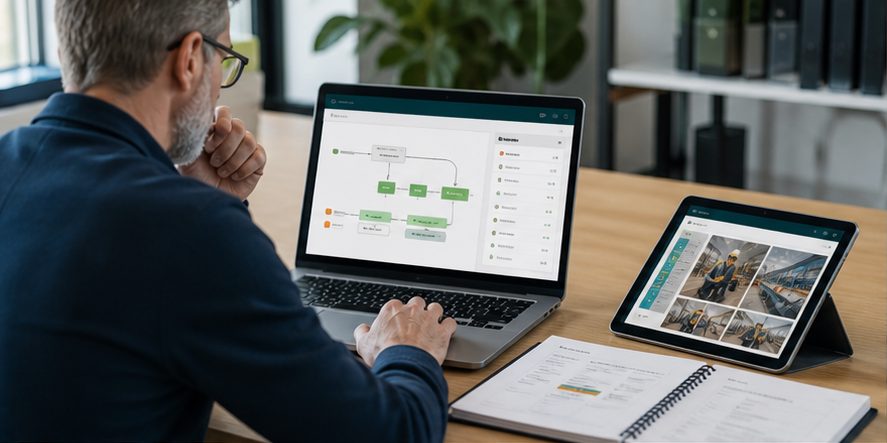
How does WorkSafe help WRMH customers turn safety management into operational advantage?
In practice, operational safety advantage needs one clear answer: the practical issue is that leaders receive a polished update but cannot see the live position behind it without asking several people. WorkSafe helps supervisors see what is open, who owns it and what evidence is still needed.
Read the full article
Why does a single risk platform give leaders clearer control?
For a single risk platform, leaders get one version of the truth across hazards, incidents, checks, actions and evidence. That reduces reconciliation time and helps managers see which risks need attention first.
Read the full article
How does WorkSafe support safer, more efficient daily operations?
In practice, safer, more efficient daily operations needs one clear answer: good control means the record explains what happened, what changed and what needs a decision. WorkSafe helps keep that trail visible for WRMH customers.
Read the full article
Why is WorkSafe available exclusively through the WRMH customer relationship?
In practice, exclusive WRMH customer access needs one clear answer: WorkSafe is positioned as a WRMH customer value-add, not a generic public software offer. That exclusivity helps WRMH wrap platform access, implementation support and operational guidance into the wider relationship.
Read the full article
How does WorkSafe help organisations move beyond disconnected safety admin?
For managers asking about moving beyond disconnected safety admin, the practical issue is that leaders receive a polished update but cannot see the live position behind it without asking several people. WorkSafe helps supervisors see what is open, who owns it and what evidence is still needed.
Read the full article
Why does better risk visibility create a stronger competitive edge?
For managers asking about better risk visibility, risk information is useful when it reflects the current operating picture. WorkSafe helps leaders compare risk status, open actions, evidence and trends so attention goes where control is changing.
Read the full article
How does WorkSafe connect frontline reporting with leadership oversight?
In practice, connecting frontline reporting with leadership oversight needs one clear answer: observations are strongest when they reach the people who can act on them. WorkSafe helps turn shop-floor input into visible actions, evidence and leadership oversight.
Read the full article
What makes WorkSafe different from a basic safety checklist system?
In practice, the difference between checklist completion and managed control needs one clear answer: the difference is completion versus control. WorkSafe connects checks to defects, owners, evidence, trends and management visibility, so supervisors can see what needs action rather than only what was completed.
Read the full article
How does faster hazard reporting reduce operational risk?
For managers asking about faster hazard reporting, the practical issue is that small warnings are corrected locally but never become visible enough to prevent a similar event elsewhere. WorkSafe helps supervisors see what is open, who owns it and what evidence is still needed.
Read the full article
Why is near-miss reporting one of the strongest early warning systems?
For managers asking about near-miss reporting, managers need location, photographs, immediate controls, investigation notes and corrective actions early enough to decide what should be escalated, investigated, trended or closed at source. WorkSafe gives WRMH customers a clearer route from record to action and proof.
Read the full article
How does WorkSafe help teams capture incidents before details are lost?
For teams capture incidents, managers need location, photographs, immediate controls, investigation notes and corrective actions early enough to decide what should be escalated, investigated, trended or closed at source. WorkSafe gives WRMH customers a clearer route from record to action and proof.
Read the full article
Why does visible incident ownership improve safety performance?
For visible incident ownership, managers need location, photographs, immediate controls, investigation notes and corrective actions early enough to decide what should be escalated, investigated, trended or closed at source. WorkSafe gives WRMH customers a clearer route from record to action and proof.
Read the full article
How does better reporting help prevent repeat events?
In practice, using better reporting to needs one clear answer: this matters because the decision is usually made while work is moving, not after a tidy report has been written. WorkSafe keeps the current position easier to review.
Read the full article
Why does frontline reporting need to be simple, fast and trusted?
For trusted frontline reporting, observations are strongest when they reach the people who can act on them. WorkSafe helps turn shop-floor input into visible actions, evidence and leadership oversight.
Read the full article
How does photo evidence improve incident investigation quality?
Where photo evidence matters, managers need finding record, containment decision, correction, preventive action, owner, due date, evidence and trend category early enough to decide whether the issue is a one-off correction, a repeat pattern, a customer-sensitive risk or a deeper control weakness. WorkSafe gives WRMH customers a clearer route from record to action and proof.
Read the full article
Why can near-miss trends reveal risk before disruption happens?
In practice, near-miss trend visibility needs one clear answer: this matters because the decision is usually made while work is moving, not after a tidy report has been written. WorkSafe keeps the current position easier to review.
Read the full article
Why does live risk visibility help leaders act before problems escalate?
For using live risk visibility to, risk information is useful when it reflects the current operating picture. WorkSafe helps leaders compare risk status, open actions, evidence and trends so attention goes where control is changing.
Read the full article
How does a live risk register improve operational control?
For managers asking about a live risk register, risk information is useful when it reflects the current operating picture. WorkSafe helps leaders compare risk status, open actions, evidence and trends so attention goes where control is changing.
Read the full article
Why can static risk assessments weaken business resilience?
For static risk assessments, the useful test is whether a manager can see the live status without rebuilding the story from messages, folders or spreadsheets.
Read the full article
How does WorkSafe help organisations see risk across sites and teams?
Where seeing risk matters, good control means the record explains what happened, what changed and what needs a decision. WorkSafe helps keep that trail visible for WRMH customers.
Read the full article
Why does real-time oversight improve safety decision-making?
For real-time oversight, risk information is useful when it reflects the current operating picture. WorkSafe helps leaders compare risk status, open actions, evidence and trends so attention goes where control is changing.
Read the full article
How does clearer risk scoring help teams prioritise action?
In practice, using clearer risk scoring to needs one clear answer: risk information is useful when it reflects the current operating picture. WorkSafe helps leaders compare risk status, open actions, evidence and trends so attention goes where control is changing.
Read the full article
Why is risk visibility becoming a competitive advantage?
For risk visibility, risk information is useful when it reflects the current operating picture. WorkSafe helps leaders compare risk status, open actions, evidence and trends so attention goes where control is changing.
Read the full article
How does connected risk data support stronger management review?
Where connected risk data matters, the useful test is whether a manager can see the live status without rebuilding the story from messages, folders or spreadsheets.
Read the full article
Why does every corrective action need a clear owner?
For managers asking about every corrective action, each task needs an owner, deadline, status and evidence requirement. WorkSafe helps managers spot drift early and see whether important findings are moving towards close-out.
Read the full article
How does action tracking reduce drift, delay and repeat findings?
In practice, action tracking needs one clear answer: each task needs an owner, deadline, status and evidence requirement. WorkSafe helps managers spot drift early and see whether important findings are moving towards close-out.
Read the full article
Why are overdue actions a hidden business risk?
For managers asking about overdue action visibility, each task needs an owner, deadline, status and evidence requirement. WorkSafe helps managers spot drift early and see whether important findings are moving towards close-out.
Read the full article
How does WorkSafe help teams prove safety actions are complete?
In practice, teams needs one clear answer: managers need owner, due date, priority, evidence, status and verification notes early enough to decide which actions need escalation, support, deadline changes or evidence before they can close. WorkSafe gives WRMH customers a clearer route from record to action and proof.
Read the full article
Why does controlled visibility improve accountability?
For controlled visibility, managers need owner, due date, priority, evidence, status and verification notes early enough to decide which actions need escalation, support, deadline changes or evidence before they can close. WorkSafe gives WRMH customers a clearer route from record to action and proof.
Read the full article
How do assigned actions turn safety concerns into measurable progress?
In practice, assigned safety actions needs one clear answer: managers need owner, due date, priority, evidence, status and verification notes early enough to decide which actions need escalation, support, deadline changes or evidence before they can close. WorkSafe gives WRMH customers a clearer route from record to action and proof.
Read the full article
Why does evidence-based close-out strengthen compliance confidence?
In practice, evidence-based close-out needs one clear answer: this matters because the decision is usually made while work is moving, not after a tidy report has been written. WorkSafe keeps the current position easier to review.
Read the full article
How does better action ownership improve supervisor efficiency?
For managers asking about better action ownership, each task needs an owner, deadline, status and evidence requirement. WorkSafe helps managers spot drift early and see whether important findings are moving towards close-out.
Read the full article
How can managers stop corrective actions being closed without real verification?
Corrective action verification is the step that checks whether the fix has actually removed or reduced the issue, not just whether a task has been marked complete.
Read the full article
How does WorkSafe help reduce audit stress before it starts?
In practice, reducing audit stress needs one clear answer: the practical issue is that the work may have been done, but the evidence trail is too scattered to prove it confidently. WorkSafe helps supervisors see what is open, who owns it and what evidence is still needed.
Read the full article
Why should compliance evidence be captured as work happens?
For capturing compliance evidence as work happens, the practical issue is that the work may have been done, but the evidence trail is too scattered to prove it confidently. WorkSafe helps supervisors see what is open, who owns it and what evidence is still needed.
Read the full article
How do centralised records improve audit readiness?
In practice, centralised records needs one clear answer: the aim is to reduce the pre-audit scramble by keeping findings, actions and close-out proof reviewable as work happens. WorkSafe helps WRMH customers see what is still open before pressure builds.
Read the full article
Why does spreadsheet-based compliance create avoidable risk?
For spreadsheet-based compliance, the practical issue is that the work may have been done, but the evidence trail is too scattered to prove it confidently. WorkSafe helps supervisors see what is open, who owns it and what evidence is still needed.
Read the full article
How does WorkSafe support stronger ISO 45001-style evidence trails?
For managers asking about stronger ISO 45001-style evidence trails, this matters because the decision is usually made while work is moving, not after a tidy report has been written. WorkSafe keeps the current position easier to review.
Read the full article
Why does live compliance visibility help leaders stay ahead?
Where using live compliance visibility to matters, the practical issue is that the work may have been done, but the evidence trail is too scattered to prove it confidently. WorkSafe helps supervisors see what is open, who owns it and what evidence is still needed.
Read the full article
How does better audit preparation protect time, confidence and reputation?
Where better audit preparation matters, the useful test is whether a manager can see the live status without rebuilding the story from messages, folders or spreadsheets.
Read the full article
Why are controlled records essential for safer, more efficient operations?
In practice, controlled records needs one clear answer: the useful test is whether a manager can see the live status without rebuilding the story from messages, folders or spreadsheets.
Read the full article
Why should audit evidence be captured during normal work instead of rebuilt later?
Audit evidence should be captured during normal work because it is more accurate, easier to trust and less dependent on memory than evidence rebuilt just before review.
Read the full article
How do quality issues become business risks when actions are not controlled?
Where quality issues matters, the useful test is whether a manager can see the live status without rebuilding the story from messages, folders or spreadsheets.
Read the full article
Why does non-conformance tracking need ownership and evidence?
For non-conformance tracking, ownership and close-out timing are where control is won or lost. WorkSafe helps managers separate correction, corrective action and verification so repeat issues are easier to spot and control.
Read the full article
How does WorkSafe help reduce repeat quality findings?
In practice, reducing repeat quality findings needs one clear answer: the useful test is whether a manager can see the live status without rebuilding the story from messages, folders or spreadsheets.
Read the full article
Why does quality management improve when teams share one evidence record?
For quality management, the practical issue is that repeat quality findings are closed locally while the underlying pattern continues under slightly different descriptions. WorkSafe helps supervisors see what is open, who owns it and what evidence is still needed.
Read the full article
How does better corrective action tracking strengthen product and service confidence?
Where better corrective action tracking matters, each task needs an owner, deadline, status and evidence requirement. WorkSafe helps managers spot drift early and see whether important findings are moving towards close-out.
Read the full article
Why does quality visibility support stronger customer assurance?
In practice, quality visibility needs one clear answer: this matters because the decision is usually made while work is moving, not after a tidy report has been written. WorkSafe keeps the current position easier to review.
Read the full article
How does trend data help quality teams act before problems escalate?
For managers asking about using trend data to, good control means the record explains what happened, what changed and what needs a decision. WorkSafe helps keep that trail visible for WRMH customers.
Read the full article
Why does connected quality and safety oversight improve operational performance?
Where connected quality and safety oversight matters, this matters because the decision is usually made while work is moving, not after a tidy report has been written. WorkSafe keeps the current position easier to review.
Read the full article
How can managers connect non-conformances, evidence and corrective actions without losing control?
Connected non-conformance management means every finding has a clear record, a named owner, supporting evidence, agreed corrective action and visible close-out. The aim is to stop issues drifting between emails, spreadsheets and meetings where the true status becomes hard to prove.
Read the full article
Why do repeat quality findings need trend visibility before they become customer issues?
Trend visibility means managers can see recurring findings by area, process, product, shift, supplier or task before they become a customer complaint or audit weakness.
Read the full article
How do technical checks reduce risk when they are visible and controlled?
For managers asking about technical checks, the useful test is whether a manager can see the live status without rebuilding the story from messages, folders or spreadsheets.
Read the full article
Why does technical assurance need more than paper records?
Where technical assurance matters, the practical issue is that a failed technical check is recorded but the operational decision and evidence trail are not strong enough to prove control. WorkSafe helps supervisors see what is open, who owns it and what evidence is still needed.
Read the full article
How does WorkSafe help teams prove operational controls are working?
For managers asking about teams, the useful test is whether a manager can see the live status without rebuilding the story from messages, folders or spreadsheets.
Read the full article
Why do equipment, process and site checks need clear evidence trails?
In practice, equipment, process and site checks needs one clear answer: the practical issue is that a failed technical check is recorded but the operational decision and evidence trail are not strong enough to prove control. WorkSafe helps supervisors see what is open, who owns it and what evidence is still needed.
Read the full article
How do technical managers gain stronger oversight through live action tracking?
For technical management oversight, each task needs an owner, deadline, status and evidence requirement. WorkSafe helps managers spot drift early and see whether important findings are moving towards close-out.
Read the full article
Why can missed technical checks become compliance and business risk?
For managers asking about missed technical checks, this matters because the decision is usually made while work is moving, not after a tidy report has been written. WorkSafe keeps the current position easier to review.
Read the full article
How does WorkSafe support practical verification of critical controls?
For practical verification of critical controls, this matters because the decision is usually made while work is moving, not after a tidy report has been written. WorkSafe keeps the current position easier to review.
Read the full article
Why does better technical visibility improve confidence across operations?
Where better technical visibility matters, managers need check result, exception detail, risk decision, action owner, supporting photographs, verification and status history early enough to decide whether the exception needs immediate correction, escalation, investigation or a change to the control plan. WorkSafe gives WRMH customers a clearer route from record to action and proof.
Read the full article
How should technical checks be linked to operational actions and evidence?
Technical checks should create a traceable route from inspection result to decision, action, evidence and verification. A failed check should not sit separately from the work needed to correct it.
Read the full article
Why can technical exceptions expose gaps between procedures and real site practice?
Technical exceptions expose procedure-practice gaps when checks show that the written standard is not being followed, understood, resourced or verified consistently.
Read the full article
How does WorkSafe support BRCGS audit readiness without adding unnecessary admin?
For BRCGS audit readiness, the aim is to reduce the pre-audit scramble by keeping findings, actions and close-out proof reviewable as work happens. WorkSafe helps WRMH customers see what is still open before pressure builds.
Read the full article
Why is BRCGS evidence stronger when actions and records are connected?
Where connected BRCGS evidence matters, strength comes from showing sequence, responsibility and verification, not just storing documents. WorkSafe helps teams connect the finding, action trail and outcome so the record is easier to test and explain.
Read the full article
How does WorkSafe help manage product safety, legality, quality and control evidence?
For managers asking about product safety and legality evidence, context matters, including what was checked, what changed and who accepted the result. WorkSafe helps technical and quality teams keep those records tied to actions and management review.
Read the full article
Why do BRCGS non-conformities need clear ownership and timely close-out?
For BRCGS non-conformity ownership, ownership and close-out timing are where control is won or lost. WorkSafe helps managers separate correction, corrective action and verification so repeat issues are easier to spot and control.
Read the full article
How does better evidence management support customer and retailer confidence?
Where customer and retailer confidence matters, the value is a faster, calmer response when evidence is requested. WorkSafe helps managers show progress, close-out and repeat-issue learning without pulling updates from several separate places.
Read the full article
Why does food safety culture benefit from visible reporting and action tracking?
In practice, food safety culture evidence needs one clear answer: people need to report concerns, see action and trust that follow-up happens. WorkSafe supports that loop by making reports, owners and evidence easier for managers to review.
Read the full article
How can BRCGS evidence be captured during normal production?
In practice, production-time BRCGS evidence needs one clear answer: the strongest records are created close to the check, finding or decision, not rebuilt afterwards. WorkSafe helps teams capture proof during normal work so preparation becomes review rather than reconstruction.
Read the full article
Why can controlled compliance visibility strengthen BRCGS preparation?
Where controlled BRCGS visibility matters, managers need to see which evidence is complete, which actions remain open and where repeat themes are forming. WorkSafe supports that review without claiming certification or audit outcomes.
Read the full article
How can BRCGS non-conformance evidence be made easier to review before audit?
BRCGS non-conformance evidence should show the finding, risk decision, immediate correction, root cause thinking, corrective action, owner, due date and close-out proof in a connected trail.
Read the full article
How should food sites sample internal audit evidence before BRCGS review?
Sample a balanced group of high-risk, repeat, overdue and recently closed findings, then trace each one from the original observation through risk assessment, ownership, action, verification and management review.
Read the full article
What should managers verify before releasing a food production line?
Before release, confirm the correct specification and materials, line clearance, hygiene status, allergen controls, equipment condition, monitoring devices and authorised sign-off, including any deviation that changes the normal decision route.
Read the full article
How can hygiene findings be escalated before they become repeat BRCGS issues?
Escalate hygiene findings according to product risk, recurrence, location and failure mode. Separate the immediate reclean from the action needed to remove the underlying cause, then schedule evidence-based verification.
Read the full article
What supplier evidence deserves live oversight in a food safety system?
Give live oversight to evidence tied to supplier approval status, material specification, declared risks, certification expiry, concessions, complaints and corrective actions. Prioritise records whose absence or change can affect use of a material or service.
Read the full article
How should food safety actions pass between shifts without losing control?
A strong handover states the affected area or product, current risk decision, temporary control, named owner, next check and escalation trigger. The incoming supervisor should acknowledge the live position before taking responsibility.
Read the full article
What should a BRCGS management review reveal about operating control?
A useful review connects objectives, audit and complaint trends, significant incidents, repeat non-conformities, overdue actions, verification results, competence gaps, supplier performance and resource constraints to explicit decisions and owners.
Read the full article
How can food sites maintain BRCGS readiness between audit windows?
Maintain readiness by mapping critical evidence to normal work, assigning ownership at the point of creation, reviewing exceptions by risk, verifying corrective actions and using management routines to challenge trends throughout the year.
Read the full article
How do pre-use equipment checks help prevent avoidable incidents?
In practice, pre-use checks and incident prevention needs one clear answer: missed checks and defects need to be visible quickly. WorkSafe helps supervisors see check status, equipment restrictions and follow-up actions before a small issue becomes a live risk.
Read the full article
Why do daily equipment checks need clear evidence and ownership?
Where daily equipment check evidence matters, missed checks and defects need to be visible quickly. WorkSafe helps supervisors see check status, equipment restrictions and follow-up actions before a small issue becomes a live risk.
Read the full article
How does WorkSafe support faster pre-use checks for operational teams?
For faster pre-use checking, missed checks and defects need to be visible quickly. WorkSafe helps supervisors see check status, equipment restrictions and follow-up actions before a small issue becomes a live risk.
Read the full article
Why do missed equipment checks create hidden safety and compliance risk?
In practice, missed pre-use checks needs one clear answer: missed checks and defects need to be visible quickly. WorkSafe helps supervisors see check status, equipment restrictions and follow-up actions before a small issue becomes a live risk.
Read the full article
How do digital pre-use records improve supervisor oversight?
For managers asking about digital pre-use records, missed checks and defects need to be visible quickly. WorkSafe helps supervisors see check status, equipment restrictions and follow-up actions before a small issue becomes a live risk.
Read the full article
Why do equipment defects need immediate visibility and action tracking?
In practice, equipment defect escalation needs one clear answer: each task needs an owner, deadline, status and evidence requirement. WorkSafe helps managers spot drift early and see whether important findings are moving towards close-out.
Read the full article
How does WorkSafe help teams prove equipment checks have been completed?
For completed check evidence, good control means the record explains what happened, what changed and what needs a decision. WorkSafe helps keep that trail visible for WRMH customers.
Read the full article
Why does better pre-use checking support safer, more efficient operations?
In practice, better pre-use checking needs one clear answer: missed checks and defects need to be visible quickly. WorkSafe helps supervisors see check status, equipment restrictions and follow-up actions before a small issue becomes a live risk.
Read the full article
Why is permit-to-work visibility essential for higher-risk activity?
For permit-to-work visibility, supervisors need the live status of higher-risk work, not just a signed form. WorkSafe shows approvals, conditions, changes and close-out evidence while work is active.
Read the full article
How does WorkSafe help control permits, approvals and evidence?
Where permit approvals and evidence matters, the practical issue is that work continues under an old approval while the real job scope, time window or control condition has changed. WorkSafe helps supervisors see what is open, who owns it and what evidence is still needed.
Read the full article
Why do disconnected permit records create unnecessary operational risk?
In practice, disconnected permit records needs one clear answer: the practical issue is that work continues under an old approval while the real job scope, time window or control condition has changed. WorkSafe helps supervisors see what is open, who owns it and what evidence is still needed.
Read the full article
How does live permit oversight help supervisors manage work safely?
Where live permit oversight matters, managers need permit request, approval route, control conditions, isolations, scope changes, photographs and final close-out early enough to decide whether the job is approved, active, paused, extended, changed or safe to hand back. WorkSafe gives WRMH customers a clearer route from record to action and proof.
Read the full article
Why do permit conditions need clear ownership and close-out?
For permit condition ownership, supervisors need the live status of higher-risk work, not just a signed form. WorkSafe shows approvals, conditions, changes and close-out evidence while work is active.
Read the full article
How does WorkSafe support safer coordination of authorised work?
For safer coordination of authorised work, competence matters most at the point work is allocated. WorkSafe helps supervisors see training, authorisation and refresher status so tasks can be matched to people with the right evidence behind them.
Read the full article
Why do permit-to-work records matter for audit and compliance confidence?
For managers asking about permit-to-work records, supervisors need the live status of higher-risk work, not just a signed form. WorkSafe shows approvals, conditions, changes and close-out evidence while work is active.
Read the full article
How does better permit management reduce delay, confusion and exposure?
For better permit management, this matters because the decision is usually made while work is moving, not after a tidy report has been written. WorkSafe keeps the current position easier to review.
Read the full article
How does WorkSafe help keep contractors inside the safety system?
For managers asking about contractors inside the safety system, contractor work should sit inside the same control system as employee activity when it affects site risk. WorkSafe connects induction, RAMS, permits, actions and evidence for easier supervision.
Read the full article
Why is contractor visibility essential for safer site operations?
In practice, contractor visibility needs one clear answer: contractor work should sit inside the same control system as employee activity when it affects site risk. WorkSafe connects induction, RAMS, permits, actions and evidence for easier supervision.
Read the full article
How does better contractor management reduce compliance risk?
Where better contractor management matters, contractor work should sit inside the same control system as employee activity when it affects site risk. WorkSafe connects induction, RAMS, permits, actions and evidence for easier supervision.
Read the full article
Why do inductions, permits and actions need one connected record?
Where inductions, permits and actions matters, the useful test is whether a manager can see the live status without rebuilding the story from messages, folders or spreadsheets.
Read the full article
How does WorkSafe improve oversight of contractor activity?
For managers asking about contractor activity oversight, site hosts need to know who is on site, what task is approved and whether conditions have changed. WorkSafe gives supervisors a live view of contractor status, location, permits and open issues.
Read the full article
Why does contractor evidence matter for audits and customer assurance?
For managers asking about contractor evidence, contractor work should sit inside the same control system as employee activity when it affects site risk. WorkSafe connects induction, RAMS, permits, actions and evidence for easier supervision.
Read the full article
How does live action tracking improve contractor accountability?
For contractor accountability, actions raised during contractor work need owners, deadlines and close-out evidence. WorkSafe helps prevent handover gaps by keeping contractor follow-up visible after the job has moved on.
Read the full article
Why do market-leading sites manage contractors with the same discipline as employees?
For managers asking about market-leading sites, contractor work should sit inside the same control system as employee activity when it affects site risk. WorkSafe connects induction, RAMS, permits, actions and evidence for easier supervision.
Read the full article
Why is competence visibility critical for safer task allocation?
Where competence visibility matters, competence matters most at the point work is allocated. WorkSafe helps supervisors see training, authorisation and refresher status so tasks can be matched to people with the right evidence behind them.
Read the full article
How does WorkSafe help connect skills, training and operational risk?
For skills and operational risk, competence matters most at the point work is allocated. WorkSafe helps supervisors see training, authorisation and refresher status so tasks can be matched to people with the right evidence behind them.
Read the full article
Why do expired training records create avoidable compliance risk?
For managers asking about expired training records, competence matters most at the point work is allocated. WorkSafe helps supervisors see training, authorisation and refresher status so tasks can be matched to people with the right evidence behind them.
Read the full article
How does better competence management improve workforce planning?
For better competence management, competence matters most at the point work is allocated. WorkSafe helps supervisors see training, authorisation and refresher status so tasks can be matched to people with the right evidence behind them.
Read the full article
Why do supervisors need live visibility of who is authorised for each task?
For supervisor competence visibility, competence matters most at the point work is allocated. WorkSafe helps supervisors see training, authorisation and refresher status so tasks can be matched to people with the right evidence behind them.
Read the full article
How does WorkSafe support training evidence and refresher planning?
Where training evidence and refresher planning matters, competence matters most at the point work is allocated. WorkSafe helps supervisors see training, authorisation and refresher status so tasks can be matched to people with the right evidence behind them.
Read the full article
Why should skills gaps be managed before they affect performance?
In practice, skills gaps be managed needs one clear answer: competence matters most at the point work is allocated. WorkSafe helps supervisors see training, authorisation and refresher status so tasks can be matched to people with the right evidence behind them.
Read the full article
How do competence records strengthen audit readiness and customer confidence?
In practice, competence records needs one clear answer: the aim is to reduce the pre-audit scramble by keeping findings, actions and close-out proof reviewable as work happens. WorkSafe helps WRMH customers see what is still open before pressure builds.
Read the full article
How do competence gaps create repeat non-conformances in quality and technical work?
Competence gaps create repeat non-conformances when managers cannot clearly see who is trained, authorised and confident to perform a task before allocating the work.
Read the full article
How does better RAMS management improve control of higher-risk work?
Where RAMS control for higher-risk work matters, higher-risk work needs a method, risk controls and action trail that match the real job. WorkSafe helps managers connect RAMS to permits, competence and evidence instead of treating them as a standalone document.
Read the full article
Why should RAMS be live, accessible and linked to action?
For live RAMS access, the people doing and supervising the work need the current version while decisions are being made. WorkSafe keeps RAMS close to the action trail so changes, briefings and follow-up do not drift.
Read the full article
How does WorkSafe support clearer RAMS generation and review?
For RAMS generation and review, the value is in making the method specific enough for the task, site and people involved. WorkSafe helps WRMH customers manage version control, approvals and later review in one place.
Read the full article
Why can outdated RAMS create safety, quality and compliance exposure?
For managers asking about outdated RAMS, old documents can look reassuring while the task, contractor, equipment or work area has changed. WorkSafe helps managers see whether the approved method still matches the live job conditions.
Read the full article
How do managed RAMS records improve contractor and supervisor confidence?
Where managed RAMS records matters, contractors and supervisors need confidence that the agreed method is current, briefed and connected to the right controls. WorkSafe links RAMS records with permits, actions and close-out evidence.
Read the full article
Why does RAMS evidence matter before, during and after work?
For RAMS evidence, useful proof exists before, during and after the work, not only at approval stage. WorkSafe helps capture the briefings, permit links, changes and close-out evidence that show how the task was controlled.
Read the full article
How does WorkSafe help teams connect RAMS to permits, competence and controls?
In practice, teams connect RAMS to permits, competence and controls needs one clear answer: these controls only work properly when managers can see them together. WorkSafe helps show whether the method, authorisation, people and live permit conditions line up before work proceeds.
Read the full article
Why does controlled RAMS management reduce delay and strengthen assurance?
For controlled RAMS management, delays reduce when the right version, approval status and evidence are easy to find. WorkSafe gives managers a clearer view of what is ready, what has changed and what still needs review.
Read the full article
How can WRMH customers introduce WorkSafe without overwhelming teams?
Where introducing WorkSafe matters, the practical issue is that software is launched before the organisation agrees how work should flow through it. WorkSafe helps supervisors see what is open, who owns it and what evidence is still needed.
Read the full article
Why do simple access levels make safety software easier to adopt?
Where simple access levels matters, managers need roles, sites, workflows, notification routes, dashboards and support requirements early enough to decide who needs access, what they should see, and which workflows should be configured first. WorkSafe gives WRMH customers a clearer route from record to action and proof.
Read the full article
How does WorkSafe support leaders, supervisors and frontline users?
Where leaders, supervisors and frontline users matters, managers need roles, sites, workflows, notification routes, dashboards and support requirements early enough to decide who needs access, what they should see, and which workflows should be configured first. WorkSafe gives WRMH customers a clearer route from record to action and proof.
Read the full article
Why does successful implementation start with clear operational priorities?
For successful implementation, this matters because the decision is usually made while work is moving, not after a tidy report has been written. WorkSafe keeps the current position easier to review.
Read the full article
How does role-based access improve control and confidence?
For managers asking about role-based access, the practical issue is that software is launched before the organisation agrees how work should flow through it. WorkSafe helps supervisors see what is open, who owns it and what evidence is still needed.
Read the full article
Why does customer support matter when safety systems become business critical?
Managers need roles, sites, workflows, notification routes, dashboards and support requirements early enough to decide who needs access, what they should see, and which workflows should be configured first. WorkSafe gives WRMH customers a clearer route from record to action and proof.
Read the full article
How does WorkSafe help teams move from manual admin to managed workflows?
For teams move from manual admin to managed workflows, the useful test is whether a manager can see the live status without rebuilding the story from messages, folders or spreadsheets.
Read the full article
Why can phased access improve adoption and long-term value?
For phased access, good control means the record explains what happened, what changed and what needs a decision. WorkSafe helps keep that trail visible for WRMH customers.
Read the full article
How do safer operations create measurable business advantage?
For safer operations as business advantage, the practical issue is that the business creates useful evidence but cannot use it to support decisions, tenders or customer confidence. WorkSafe helps supervisors see what is open, who owns it and what evidence is still needed.
Read the full article
Why does reduced risk improve customer confidence and operational performance?
For managers asking about reduced risk, this matters because the decision is usually made while work is moving, not after a tidy report has been written. WorkSafe keeps the current position easier to review.
Read the full article
How does WorkSafe help organisations demonstrate compliance with confidence?
In practice, demonstrating compliance with confidence needs one clear answer: this matters because the decision is usually made while work is moving, not after a tidy report has been written. WorkSafe keeps the current position easier to review.
Read the full article
Why can better safety oversight protect reputation and growth?
For managers asking about better safety oversight, good control means the record explains what happened, what changed and what needs a decision. WorkSafe helps keep that trail visible for WRMH customers.
Read the full article
How does risk management software support competitive tendering and assurance?
In practice, risk management software needs one clear answer: the practical issue is that the business creates useful evidence but cannot use it to support decisions, tenders or customer confidence. WorkSafe helps supervisors see what is open, who owns it and what evidence is still needed.
Read the full article
Why do fewer surprises make operations more efficient and resilient?
In practice, fewer surprises needs one clear answer: the useful test is whether a manager can see the live status without rebuilding the story from messages, folders or spreadsheets.
Read the full article
How does WorkSafe help turn compliance work into leadership insight?
In practice, turning compliance work into leadership insight needs one clear answer: the useful test is whether a manager can see the live status without rebuilding the story from messages, folders or spreadsheets.
Read the full article
Why do market-leading organisations treat safety data as business intelligence?
For safety data as business intelligence, this matters because the decision is usually made while work is moving, not after a tidy report has been written. WorkSafe keeps the current position easier to review.
Read the full article
How does a controlled evidence trail improve customer confidence and commercial resilience?
A controlled evidence trail improves confidence because it shows that findings, checks, actions and decisions are managed consistently rather than reconstructed under pressure.
Read the full article
How does WorkSafe support safer operations across different sectors?
For sector-specific safer operations, the practical issue is that the same generic process is used everywhere, even where local risk, customer expectations or operating pressure differ. WorkSafe helps supervisors see what is open, who owns it and what evidence is still needed.
Read the full article
Why does sector-specific risk visibility improve business performance?
Where sector-specific risk visibility matters, risk information is useful when it reflects the current operating picture. WorkSafe helps leaders compare risk status, open actions, evidence and trends so attention goes where control is changing.
Read the full article
How does WorkSafe help organisations adapt safety controls to their operating environment?
In practice, adapting safety needs one clear answer: good control means the record explains what happened, what changed and what needs a decision. WorkSafe helps keep that trail visible for WRMH customers.
Read the full article
Why do manufacturing, logistics and warehousing teams need live risk oversight?
For managers asking about manufacturing, logistics and warehousing teams, the practical issue is that the same generic process is used everywhere, even where local risk, customer expectations or operating pressure differ. WorkSafe helps supervisors see what is open, who owns it and what evidence is still needed.
Read the full article
How does sector-focused safety management improve customer confidence?
For sector-focused safety management, this matters because the decision is usually made while work is moving, not after a tidy report has been written. WorkSafe keeps the current position easier to review.
Read the full article
Why do different sites need consistent risk control with local flexibility?
For consistent risk control, managers need sector-specific checks, hazards, permits, competence records, quality evidence and action trends early enough to decide which controls should be standardised and where local flexibility is needed. WorkSafe gives WRMH customers a clearer route from record to action and proof.
Read the full article
How does WorkSafe support sector-specific compliance evidence?
For managers asking about sector-specific compliance evidence, the useful test is whether a manager can see the live status without rebuilding the story from messages, folders or spreadsheets.
Read the full article
Why do market-leading organisations tailor safety systems to real operational risk?
For tailored safety systems, the useful test is whether a manager can see the live status without rebuilding the story from messages, folders or spreadsheets.
Read the full article